d3 = require("d3@7")

data2 = [
  {category: "Analysis & research design", pct: 31},
  {category: "Data pipelines", pct: 27},
  {category: "Operations", pct: 17},
  {category: "Writing & comms", pct: 13},
  {category: "Troubleshooting", pct: 12}
]

{
  const width = 900;
  const height = 500;

  const color = d3.scaleOrdinal()
    .domain(data2.map(d => d.category))
    .range(["#f28e2b", "#4e79a7", "#e15759", "#76b7b2", "#59a14f"]);

  const root = d3.hierarchy({children: data2})
    .sum(d => d.pct)
    .sort((a, b) => b.value - a.value);

  d3.treemap()
    .size([width, height])
    .padding(3)
    .round(true)(root);

  const svg = d3.create("svg")
    .attr("width", width)
    .attr("height", height)
    .attr("viewBox", [0, 0, width, height])
    .style("display", "block")
    .style("margin", "0 auto");

  const leaf = svg.selectAll("g")
    .data(root.leaves())
    .join("g")
    .attr("transform", d => `translate(${d.x0},${d.y0})`);

  leaf.append("rect")
    .attr("width", d => d.x1 - d.x0)
    .attr("height", d => d.y1 - d.y0)
    .attr("fill", d => color(d.data.category))
    .attr("rx", 4);

  leaf.append("foreignObject")
    .attr("width", d => d.x1 - d.x0)
    .attr("height", d => d.y1 - d.y0)
    .append("xhtml:div")
    .style("width", "100%")
    .style("height", "100%")
    .style("display", "flex")
    .style("flex-direction", "column")
    .style("align-items", "center")
    .style("justify-content", "center")
    .style("padding", "6px")
    .style("box-sizing", "border-box")
    .style("text-align", "center")
    .style("overflow", "hidden")
    .html(d => `
      <span style="font-size:${(d.x1 - d.x0) > 120 ? 26 : 18}px; font-weight:bold; color:#1a1a1a; line-height:1.2;">${d.data.category}</span>
    `);

  return svg.node();
}AI Coding Agents in an Economics Team
NABE TEC EU 2026
Alex Guglielmone Nemi
2026-05-29
How the team works
- Alex Guglielmone Nemi
- Economic Decision Science, Amazon — Engineering Lead
- Cross-functional team: Economists + Engineers
- Goal: economists deliver without engineering bottlenecks
- Fast iteration, minimal infrastructure
- No tradeoff between exploration and production
Late-2025 quality jump
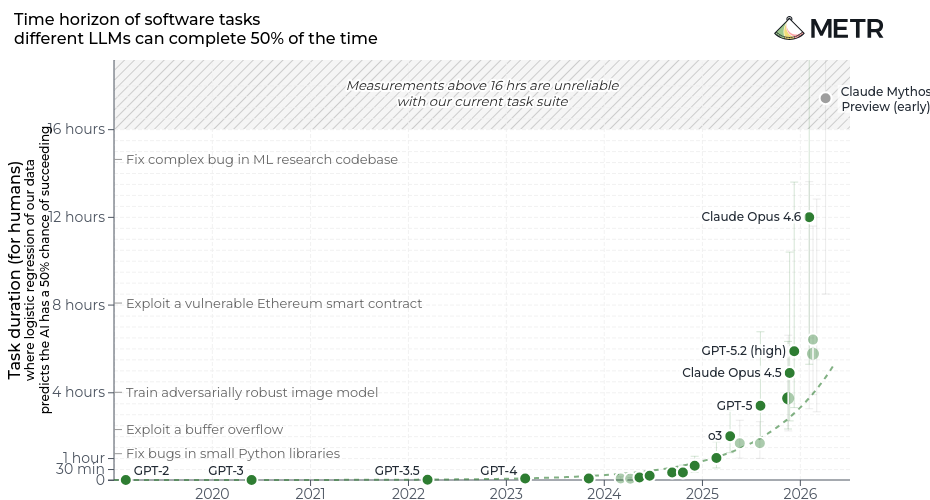
Source: METR Task Horizons · metr.org/time-horizons
How we leverage Coding Agents
1. “Explain this model to me”
- “Explain this model to me”
- Agent explains methodology step by step
- Economist spots: “that’s counting the wrong window”
- (or: wrong benchmark scope, double-counting, extensive vs intensive confusion…)
- “Fix it” → corrected pipeline in 15 minutes
2. “Help me analyze this policy”
- Economist has a policy question, no design yet
- Dialogue: what’s the right approach? assumptions? what could go wrong?
- Power analysis, clustering, spillovers. Methodology through conversation
- Complete research design
3. “Help me respond to this challenge”
- Leadership / stakeholders challenge methodology in a meeting
- Economist uses agent: pull the data, produce the chart, draft the response
- Prove it instantly instead of deferring it.
- Real data backing the argument without effort or time wasted
Quick clarification
- We also leverage AI-powered economics workflows (synthetic conjoints, model-driven scoring systems, text extraction and harmonization for assortment models)
- Coding agents are the focus: the everyday working interface
- Broad, open-ended, close to the production process
- What I’ll discuss next applies to both
What economists never delegate
1
Methodology selection — Which estimator. Which design.
2
Causal identification — How to isolate the effect.
3
Economic interpretation — Whether results make sense.
4
Stakeholder judgment — Tone, framing, politics.
5
Research taste — What questions matter.
Pain points
- Trust: “How do we know it’s right?”
- Reliability: “It worked yesterday, not today”
- Blast radius: “What happens if it goes rogue?”
- Observability: “Can’t explain what happened”
- Tool churn: “Everything keeps changing”
- Cost: “Fast iteration without runaway spend”
- Speed: “Too slow to explore effectively”
Control
The RA analogy
Same qualification. Different agent.
What an exam looks like
name: econ-model-runner
questions:
  - name: runs-scenario
    input: Run scenario for client ABC, target €100k. Scope: EU5
    intention: Agent picks the right skill and executes with correct params
    assert:
      - type: tool-called
        value: run-model --client ABC --ask 100000 --scope EU5

  - name: plans-batch-safely
    input: Run all clients under €300k, all markets, 20% above last cycle
    intention: Agent should plan before executing a large ambiguous batch
    assert:
      - type: plan-contains
        judge:
          - clarifies 'last cycle' time range
          - identifies source table
          - smoke tests one case before full run
          - estimates total effort
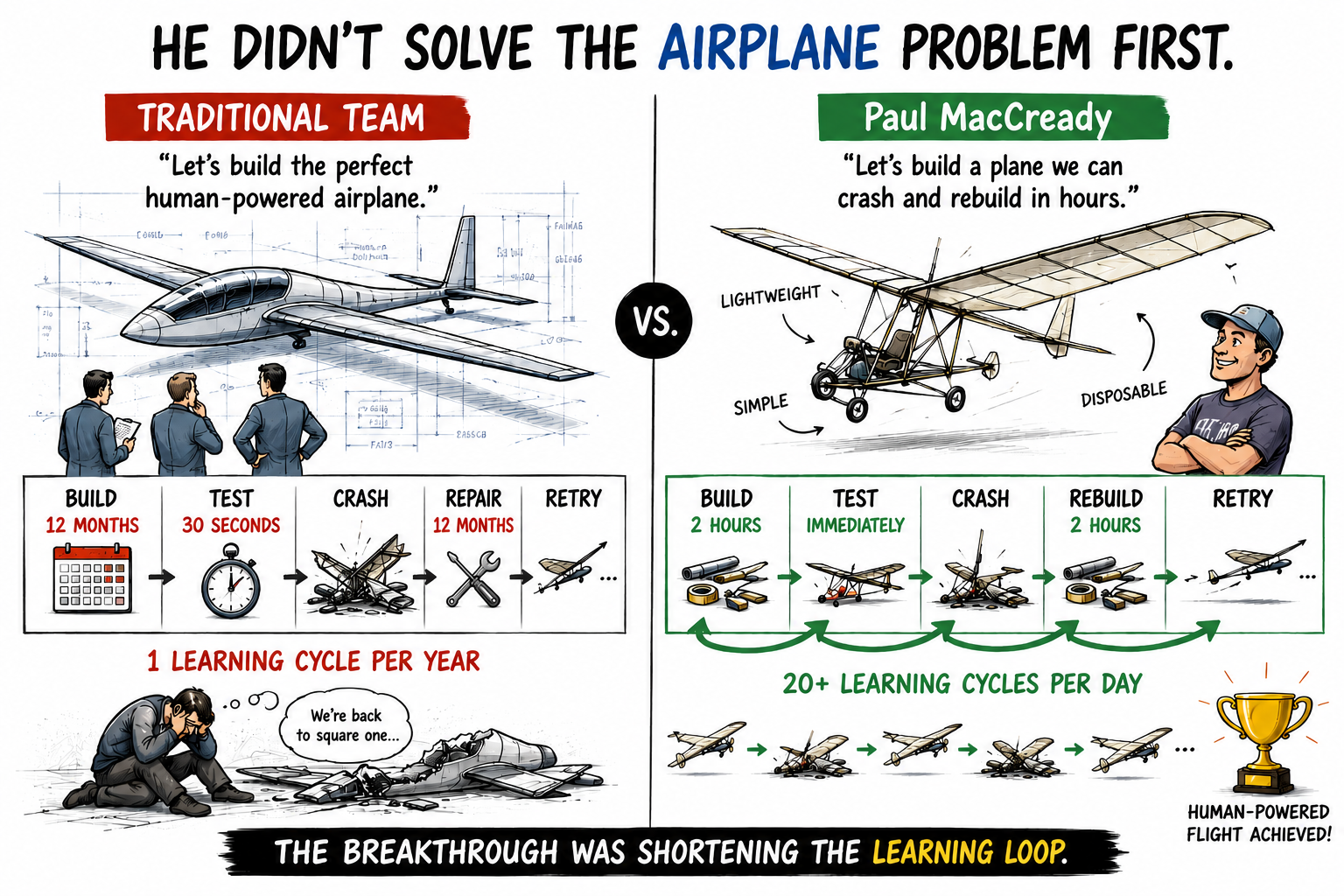
The feedback loop
Operational realities
- Slow tools kill fast iteration
- Context management is still a challenge
- Security boundaries must live outside the LLM
- Be a good boss: delegate, but own outcomes
- The agent needs to work where the economist works
Takeaways
- Sketch the workflow early. Try the UX.
- Break long tasks into testable blocks
- Use code for stable steps; use LLMs for reasoning and tool calling
- Use Exam First Iteration to keep control
Questions?
https://linktr.ee/alex.guglielmone.nemi
Writings · Github · LinkedIn