It Works! Now
What?
Fast Iteration for AI Capabilities in Airflow
Engineering Lead @ Amazon
2026-09-01
Two Worlds
A Real Example
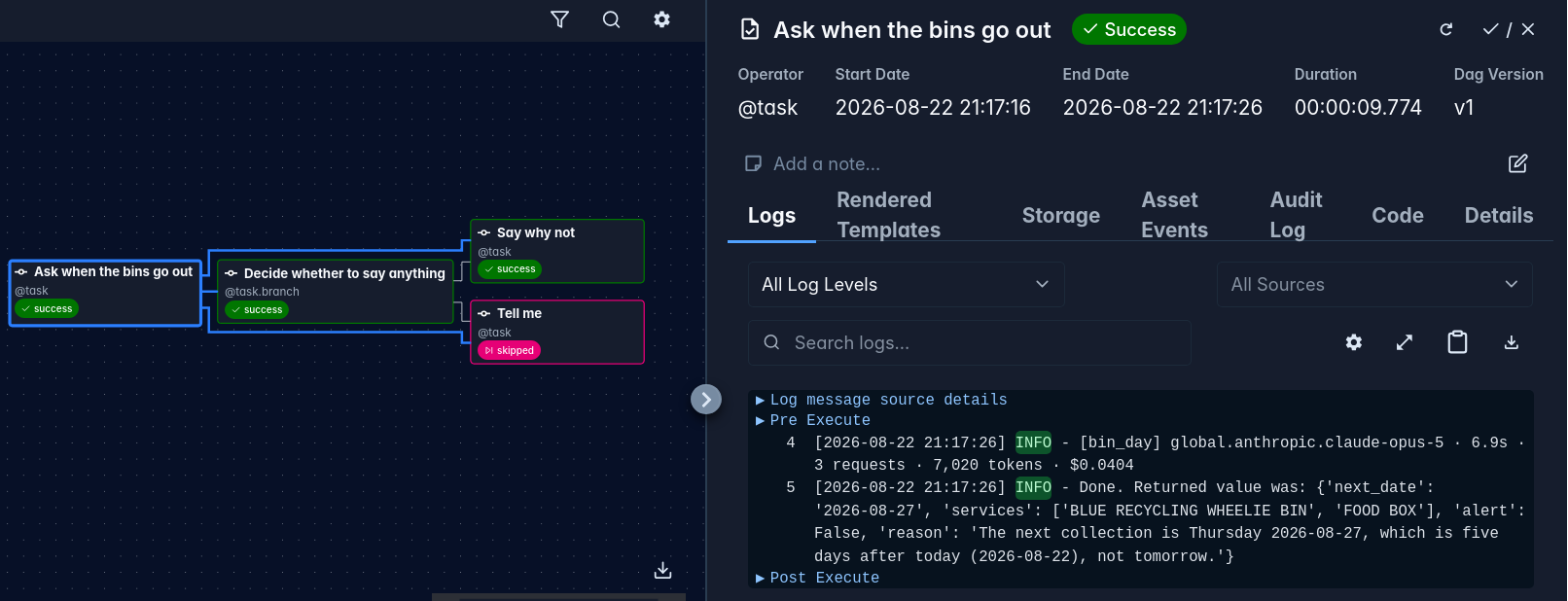
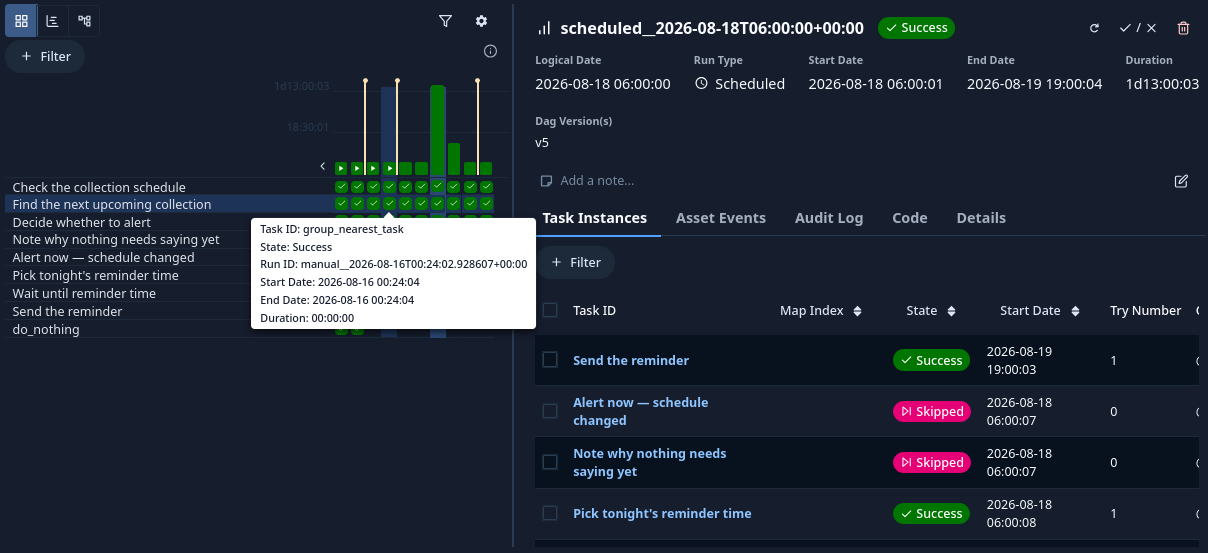
Which Bin Tomorrow?
That's a whole month of rubbish in my garden
The Agent Figures It Out
* My setup included custom context and tools. Measure your own.
It Works. Now What?
Fast Iteration Needs a Cheap Loop
Before you delegate,
build the check that tells you it's right.
You could also call it executable intent.
The Smallest Check
class BinDayFacts(BaseModel):
    next_collection_date: date
    containers_due: set[str]


def test_ordinary_week():
    facts = ask_agent(recorded("2026-08-22"))   # the council's real response, saved

    assert facts == BinDayFacts(
        next_collection_date=date(2026, 8, 27),
        containers_due={"BLUE RECYCLING WHEELIE BIN", "FOOD BOX"},
    )
PASSED  test_ordinary_week
FAILED  test_collection_pulled_forward
        - containers_due={'BLACK RUBBISH WHEELIE BIN', 'FOOD BOX'}
        + containers_due=set()
This can be called an AI eval. It is a deterministic assertion on AI-generated output.
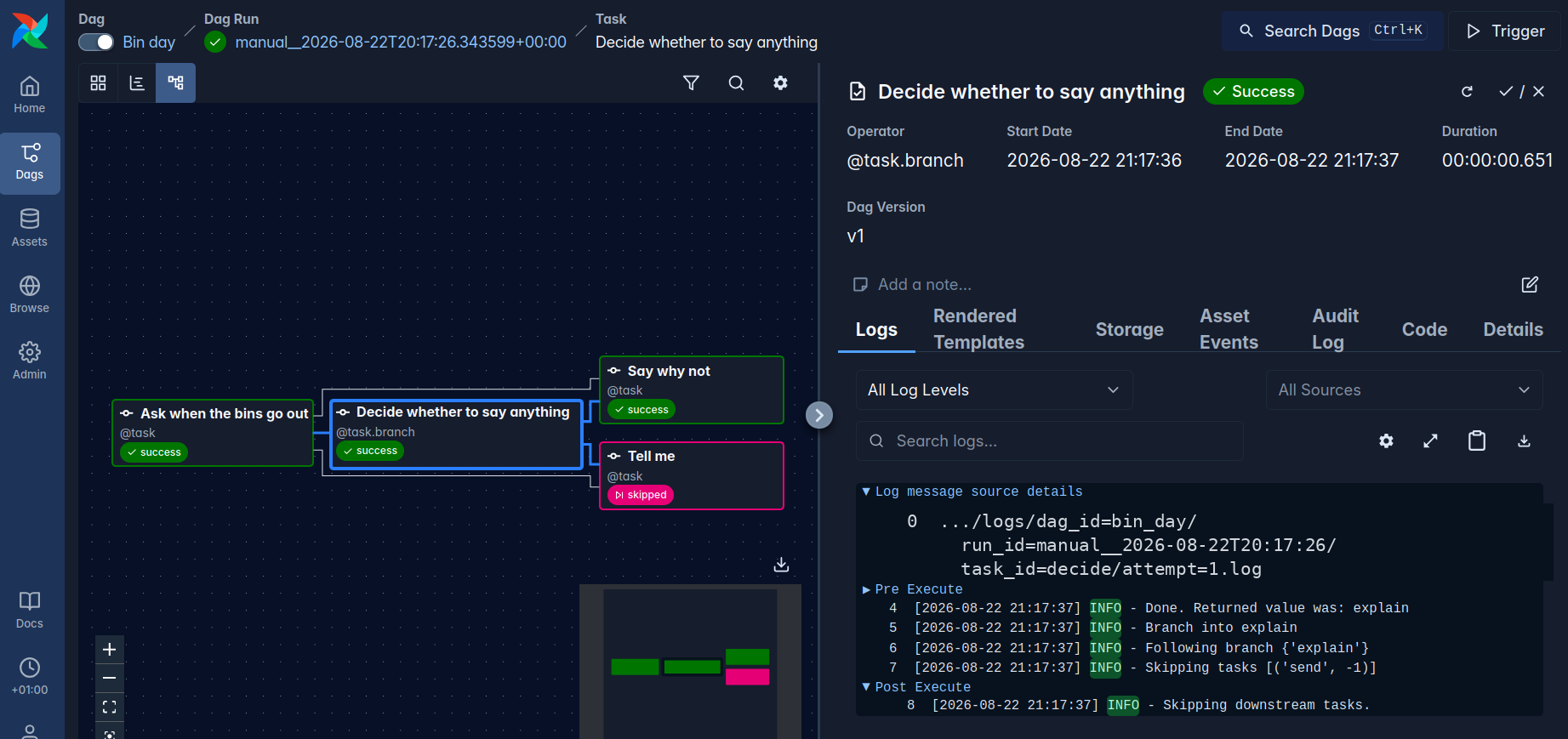
From Agent Skill to Airflow Dag
def test_alerts_only_when_the_collection_is_tomorrow():
    assert decide(facts(next="2026-08-27"), today="2026-08-26") == "send"
    assert decide(facts(next="2026-08-27"), today="2026-08-22") == "explain"

def test_does_not_say_it_twice():
    assert decide(facts(next="2026-08-27"), today="2026-08-26",
                  already_alerted="2026-08-27") == "explain"
before claude -p "Do I need to put the bins out? …" --model opus --allowedTools WebFetch WebSearch Bash(curl:*)
* Trimmed for width. Or skip the hand-rolling: apache-airflow-providers-common-ai ships AgentOperator and AgentSkillsToolset.
Change the Model
Change the Model
* One capability, one recorded world, three runs per model. Illustrative of the method, not an authoritative comparison of these models.
Making the Loop Faster
Move More Out of Inference
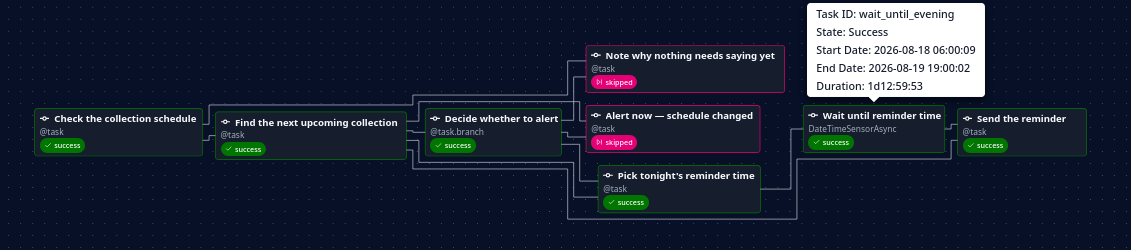
Find the Loop
Define the Box
Every lever so far has been inside a dag: the prompt, the model, the tools, the workflow.
Now my levers are: kill a worker · restart the triggerer · configure the schedulerCheap, because Airflow ships images. Just a compose file I can destroy.
Hypothesize and Prove
I'm not building this feature. I want to know it works for my cases.
Here the check is a hypothesis. True or false doesn't matter. Either way I know.
Simulate the Effect
Two Kinds of Control
Evals are not security.
Traces: How The Answer Came To Be
  2.1s  user      do I need to put the bins out? postcode <redacted>
  6.2s  Skill     bin-day loaded
 12.8s  ToolSrch  select:WebFetch                                ok
 41.8s  Bash      fetch the council waste page                   ok
 50.5s  Bash      inspect form fields and endpoints             REFUSED
 58.1s  Bash      inspect form fields                           REFUSED
 62.4s  Bash      inspect form fields                           REFUSED
 71.6s  Bash      inspect form fields and endpoints              ok
 81.2s  Bash      look up addresses for postcode                 ok
 92.5s  Bash      extract UPRN for <redacted>                   REFUSED
101.7s  Bash      fetch collection schedule for UPRN             ok
111.4s  Bash      clean up temporary lookup files               REFUSED
115.8s  Bash      clean up temporary lookup files               REFUSED
124.2s  answer    Thursday 27 Aug · BLUE RECYCLING WHEELIE BIN, FOOD BOX
* Trimmed for width: 14 of 26 events. 16×Bash, 2×Read, 1×Skill, 1×ToolSearch. 989,639 tokens for three rows of a table — and ~30k of that was my harness, before the task started.
Prod Traces Capture Your Next Check
You were never going to predict every case. We didn't manage that with ordinary software either.
  def test_ordinary_week(): ...
  def test_collection_pulled_forward(): ...
+ def test_bank_holiday_moves_the_whole_week():
+     facts = ask_agent(recorded("2026-08-25"))
+     assert facts.next_collection_date == date(2026, 8, 28)
Make Good Checks Easy to Write
A qualifying exam for a domain, before we let an agent work in it.
Takeaways
Evals are not security. If something must never happen, prevent it rather than evaluating it.
Questions?

Alex Guglielmone Nemi · Airflow Summit 2026 · Austin, TX
Tux, after Larry Ewing